
Replacing Plastic Guttering with Cast Iron: A Complete Guide
Discover how to replace plastic guttering with cast iron and what to consider when restoring a traditional or period property.
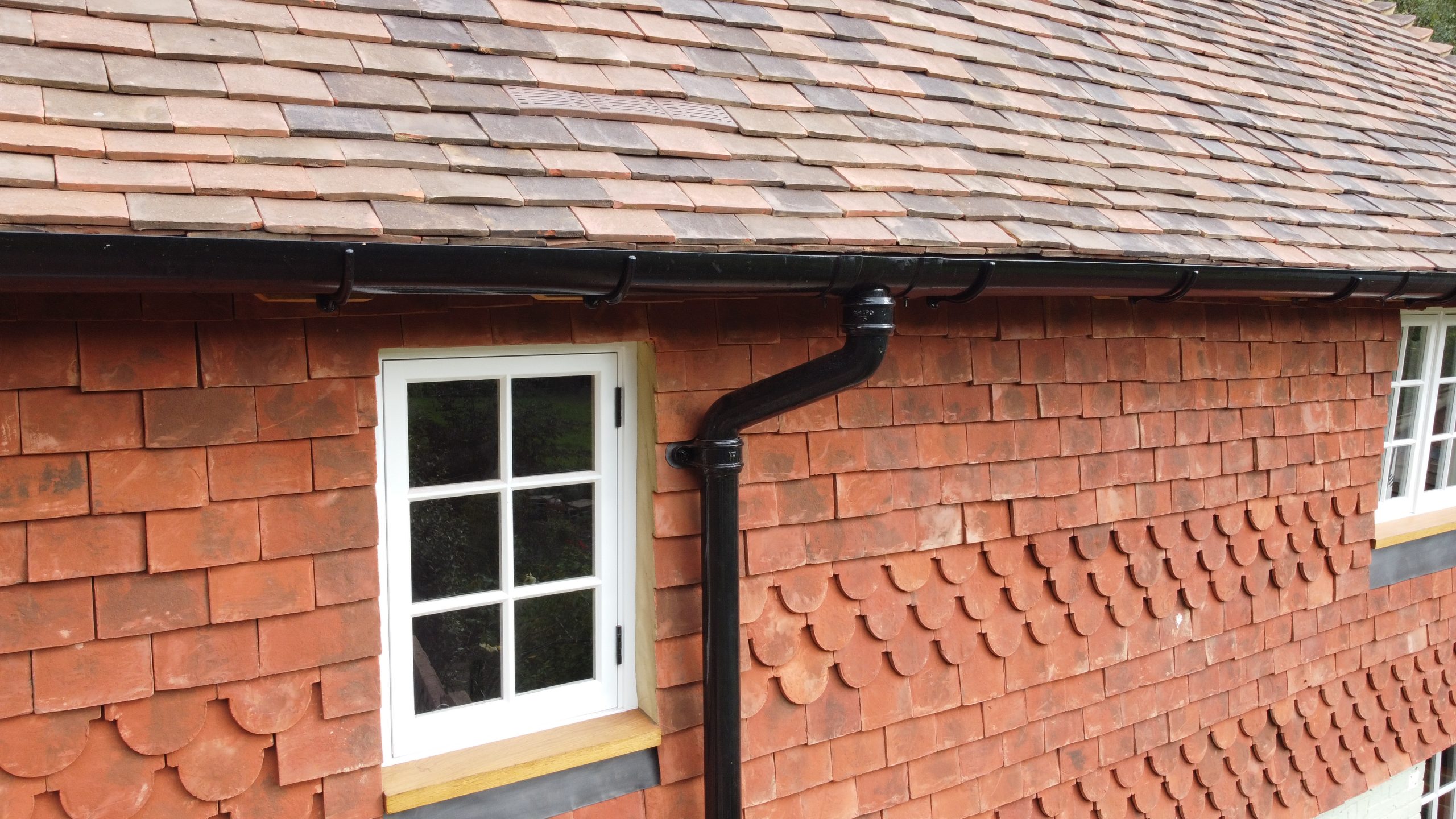
Can You Replace Plastic Guttering with Cast Iron?
Yes, plastic guttering can usually be replaced with cast iron guttering, and on a period or heritage property the transformation can be considerable.
Guttering is easy to regard as a purely functional part of a building. In reality, gutters and downpipes are highly visible architectural details. They run around the roofline and down external elevations, meaning the choice of material, profile, brackets and fittings can have a significant impact on how a property looks.
Standard PVCu guttering provides a practical and economical rainwater solution, but it can sometimes appear out of place on an older building.
Replacing plastic gutters and downpipes with a traditional cast iron rainwater system can help restore character and create detailing more sympathetic to the architecture.
However, changing from lightweight plastic to cast iron isn’t always a straightforward like-for-like swap.
Here’s what you need to consider.
Why replace plastic guttering with cast iron?
There are several reasons homeowners choose to replace plastic gutters with cast iron.
To restore traditional character
This is often the main reason.
Many older British buildings would originally have been fitted with traditional metal rainwater goods. Over the years, these may have been removed and replaced with inexpensive plastic systems.
While the plastic may perform adequately, its appearance can be noticeably different from traditional cast iron.
Reinstating cast iron can restore:
- Traditional gutter profiles
- Substantial downpipes
- Traditional sockets and joints
- Period-style brackets
- Cast iron outlets
- Decorative rainwater hoppers
Taken together, these relatively small details can make a substantial difference to the exterior of a period property.
Does cast iron guttering look better than plastic?
That’s ultimately a matter of taste, but on many period and heritage properties, genuine cast iron provides an appearance much closer to traditional rainwater goods.
Cast iron has a distinctive solidity, texture and level of detailing.
Plastic guttering is manufactured differently and tends to have smoother surfaces, lightweight moulded fittings and different jointing arrangements.
Those differences can be particularly noticeable on buildings constructed from traditional materials such as:
- Brick
- Natural stone
- Flint
- Timber
- Slate
- Clay tiles
The objective isn’t necessarily to make the guttering a prominent feature. Good traditional rainwater goods should complement the architecture and look as though they belong there.
Is cast iron guttering only suitable for old houses?
No.
While cast iron guttering is particularly associated with period properties, listed buildings and heritage restoration, it can also be used on new buildings.
It is especially effective on:
- Traditional new-build homes
- Barn-style developments
- Country houses
- High-quality extensions
- Heritage-style developments
- Properties designed using vernacular architecture
Where architectural detailing and longevity are priorities, cast iron can provide a distinctive alternative to lightweight modern rainwater systems.
Can I use the same brackets when changing from plastic to cast iron?
Usually not.
One of the biggest practical differences between plastic and cast iron guttering is weight.
Cast iron is substantially heavier.
The existing plastic gutter brackets and fixings shouldn’t simply be assumed suitable for supporting a cast iron rainwater system.
Depending on the property and installation, cast iron guttering can use:
- Fascia brackets
- Side-fix rafter brackets
- Top-fix rafter brackets
- Rise-and-fall brackets
- Other traditional support arrangements
The brackets and their fixings need to be appropriate for the gutter profile, building and load.
This is particularly important on older buildings where the condition of timber fascias, rafters or masonry may also need consideration.
Do I need a fascia board for cast iron guttering?
Not necessarily.
One advantage of traditional rainwater systems is that different bracket arrangements allow gutters to be installed on buildings without conventional fascia boards.
Rafter brackets can provide a solution where the gutter is supported directly from the roof structure.
This can be particularly useful on traditional cottages, barns and historic buildings where adding a modern fascia board purely to support guttering would be inappropriate.
The correct bracket arrangement depends on the construction of the individual property.
Which cast iron gutter profile should replace plastic guttering?
Don’t automatically copy the profile of the existing plastic gutter.
If the plastic system is a later alteration, it may have little relationship to the property’s original rainwater goods.
Instead, consider the architecture.
Common traditional cast iron gutter profiles include:
Half Round
A simple curved profile that works particularly well across a broad range of traditional properties.
Beaded Half Round
Similar to Half Round but with an additional raised bead providing subtle traditional detailing.
Ogee
A more decorative moulded profile that can form a stronger architectural feature.
If you’re unsure which is appropriate, look for historical evidence.
Old photographs of the property can be particularly valuable.
You may also find clues from surviving brackets, outlets or sections of original guttering elsewhere on the building.
Suggested internal link: Choosing the Right Cast Iron Gutter Profile for Your Property
What size cast iron guttering do I need?
Don’t assume that the size of your existing plastic gutter is automatically the correct size for the new cast iron system.
The gutter needs enough capacity to deal with the water draining from the roof.
The appropriate size depends on factors including:
- Roof area
- Roof pitch
- Rainfall intensity
- Gutter profile
- Number of outlets
- Outlet positions
- Downpipe capacity
If the existing plastic system frequently overflows during heavy rainfall, simply replicating its dimensions in cast iron may reproduce the same problem.
Changing the rainwater system provides an opportunity to check that its capacity is appropriate.
Do I need to replace the plastic downpipes as well?
Not necessarily from a purely functional perspective, but if your objective is to restore a traditional appearance, replacing the downpipes can make an even bigger visual difference than changing the gutters.
Downpipes run vertically across the elevation and are therefore highly visible.
Traditional cast iron downpipes typically feature substantial sockets, brackets and fittings that form part of the character of the rainwater system.
A complete cast iron installation can include:
- Cast iron downpipes
- Pipe sockets
- Bends
- Branches
- Wall brackets
- Shoes
- Rainwater hoppers
Replacing both gutters and downpipes creates a much more coherent traditional appearance.
Can cast iron gutters connect to plastic downpipes?
It may be possible to create a suitable connection between different rainwater materials, depending on the products and dimensions involved.
However, mixing systems needs to be considered carefully.
Apart from technical compatibility, there’s an aesthetic question.
A traditional cast iron gutter connected immediately to a lightweight plastic downpipe may undermine much of the visual benefit of changing materials.
If budget prevents replacing the complete system at once, it may still be possible to approach the project in stages.
What about rainwater hoppers?
If you’re upgrading a period property, cast iron rainwater hoppers are worth considering.
A hopper collects rainwater from one or more sources before directing it into a downpipe.
Traditional cast iron hoppers can range from simple functional designs to highly decorative architectural features.
On the right building, introducing an appropriate traditional hopper can add considerably more character than a basic modern outlet arrangement.
Can I replace plastic guttering with cast iron on a listed building?
Potentially, but extra care is required.
A listed building may currently have plastic guttering that was installed during an earlier alteration, but that doesn’t automatically tell you what should replace it.
Try to establish the historic rainwater arrangement.
Evidence might include:
- Old photographs
- Original drawings
- Surviving guttering elsewhere
- Historic brackets
- Fixing marks
- Similar neighbouring buildings
- Other documentary evidence
If the proposed work could affect the special architectural or historic interest of the property, Listed Building Consent may be required.
Speak to the relevant conservation officer or local planning authority before making significant alterations.
Is replacing plastic with cast iron difficult?
Cast iron requires different handling and installation considerations because of its weight and traditional construction.
Accurate setting out is particularly important.
The installation needs to consider:
- Structural support
- Correct bracket spacing
- Gutter fall
- Jointing
- Outlets
- Downpipe alignment
- Fixing into the building
- Connection to drainage
For anything beyond a straightforward installation, using a contractor experienced with cast iron rainwater goods is worth considering.
Can cast iron guttering be installed on timber fascia?
Yes, subject to the fascia and supporting structure being suitable.
Cast iron fascia brackets are available for traditional installations.
However, the existing fascia needs to be capable of supporting the loads involved.
If you’re replacing lightweight plastic guttering, don’t simply assume that the existing fascia and fixings are adequate.
The condition and construction should be assessed before installation.
How much does it cost to replace plastic guttering with cast iron?
The cost varies considerably depending on:
- Size of the property
- Gutter profile
- Gutter dimensions
- Number of downpipes
- Number of corners
- Hoppers
- Bracket arrangement
- Access
- Scaffolding requirements
- Installation complexity
- Decorative fittings
Genuine cast iron will generally involve a higher initial investment than standard plastic guttering.
However, initial price isn’t the only consideration.
Traditional cast iron offers durability, repairability, architectural authenticity and a potentially very long service lifewhen correctly installed and maintained.
On a period property, there is also the less easily quantified benefit of using a material that complements the architecture.
How long will cast iron guttering last?
A properly installed and maintained cast iron rainwater system can remain in service for many decades.
Unlike products that are simply discarded when they deteriorate, cast iron can be:
- Inspected
- Cleaned
- Repaired
- Repainted
- Locally replaced
Individual components can often be changed without replacing the complete system.
This makes ongoing maintenance an important part of maximising its lifespan.
Does cast iron guttering need more maintenance than plastic?
Cast iron does require periodic maintenance of its protective finish.
Plastic generally doesn’t require painting.
However, all rainwater systems require maintenance.
Plastic gutters can still become blocked, joints can leak, brackets can fail and outlets need clearing.
The difference is that traditional cast iron is designed to be maintained and can remain in service for a very long time when properly cared for.
Is cast iron guttering worth the extra cost?
That depends on the property and your priorities.
For a modern utility building where the lowest possible installation cost is the main consideration, cast iron may be difficult to justify.
For a period home, listed building, heritage property or high-quality traditional development, the calculation is different.
You’re investing in:
- Authentic material
- Traditional appearance
- Durability
- Repairability
- Architectural detailing
- Long-term performance
Perhaps most importantly, you’re choosing rainwater goods that complement rather than detract from the building.
Planning your switch from plastic to cast iron
Before ordering anything, work through these steps:
1. Look at the building
Consider its age, architecture and existing traditional details.
2. Research the original rainwater goods
Look for old photographs or surviving components.
3. Choose the gutter profile
Half Round, Beaded Half Round, Ogee or another appropriate profile.
4. Establish the required capacity
Make sure the system can handle the roof drainage requirements.
5. Decide on brackets and fixings
Don’t reuse plastic brackets.
6. Consider the complete system
Think about gutters, outlets, downpipes, hoppers, bends, shoes and brackets together.
7. Check the building structure
Make sure suitable fixing points are available.
8. Consider conservation requirements
Especially for listed buildings and sensitive heritage projects.
9. Measure carefully
Accurate dimensions will help avoid ordering problems.
10. Ask for advice
If you’re uncertain, get help before placing the order.
Need help replacing plastic guttering with cast iron?
At Forge Heritage, we specialise in traditional rainwater systems for period, heritage and character properties.
Our ranges include cast iron gutters, cast iron downpipes, rainwater hoppers, brackets, outlets and associated fittings, allowing you to create a complete traditional rainwater system.
If you’re replacing an existing plastic system, send us photographs of your property together with some basic dimensions.
Our experienced team can help you choose an appropriate cast iron gutter profile, size, brackets, downpipes and fittings for your project.
You don’t need to know exactly what you need before contacting us – that’s what we’re here to help with.
Frequently Asked Questions
Can plastic guttering be replaced with cast iron?
Yes. Plastic guttering can usually be replaced with cast iron, provided the new system is correctly sized and appropriate brackets, fixings and structural support are used.
Can I use existing plastic gutter brackets for cast iron?
No. Plastic gutter brackets shouldn’t be assumed capable of supporting cast iron. Use brackets and fixings appropriate to the cast iron gutter profile and installation.
Is cast iron guttering heavier than plastic?
Yes. Cast iron is substantially heavier than PVCu guttering, so supporting brackets, fixings, fascia boards or rafters need to be suitable for the additional load.
What cast iron gutter profile should replace plastic guttering?
The best profile depends on the architecture of the property rather than the existing plastic gutter. Half Round, Beaded Half Round and Ogee are common traditional cast iron gutter profiles.
Should I replace plastic downpipes with cast iron too?
You don’t necessarily have to, but replacing gutters and downpipes together generally creates a much more coherent traditional appearance on a period property.
Can I replace plastic guttering with cast iron on a listed building?
Potentially, but you should investigate the building’s original rainwater goods and establish whether Listed Building Consent or conservation advice is required before making alterations.
Is cast iron guttering worth the cost?
For period and heritage properties, cast iron can justify its higher initial cost through its traditional appearance, durability, repairability and potentially very long service life.